Appearance of the Cross on the Synagogue Roof
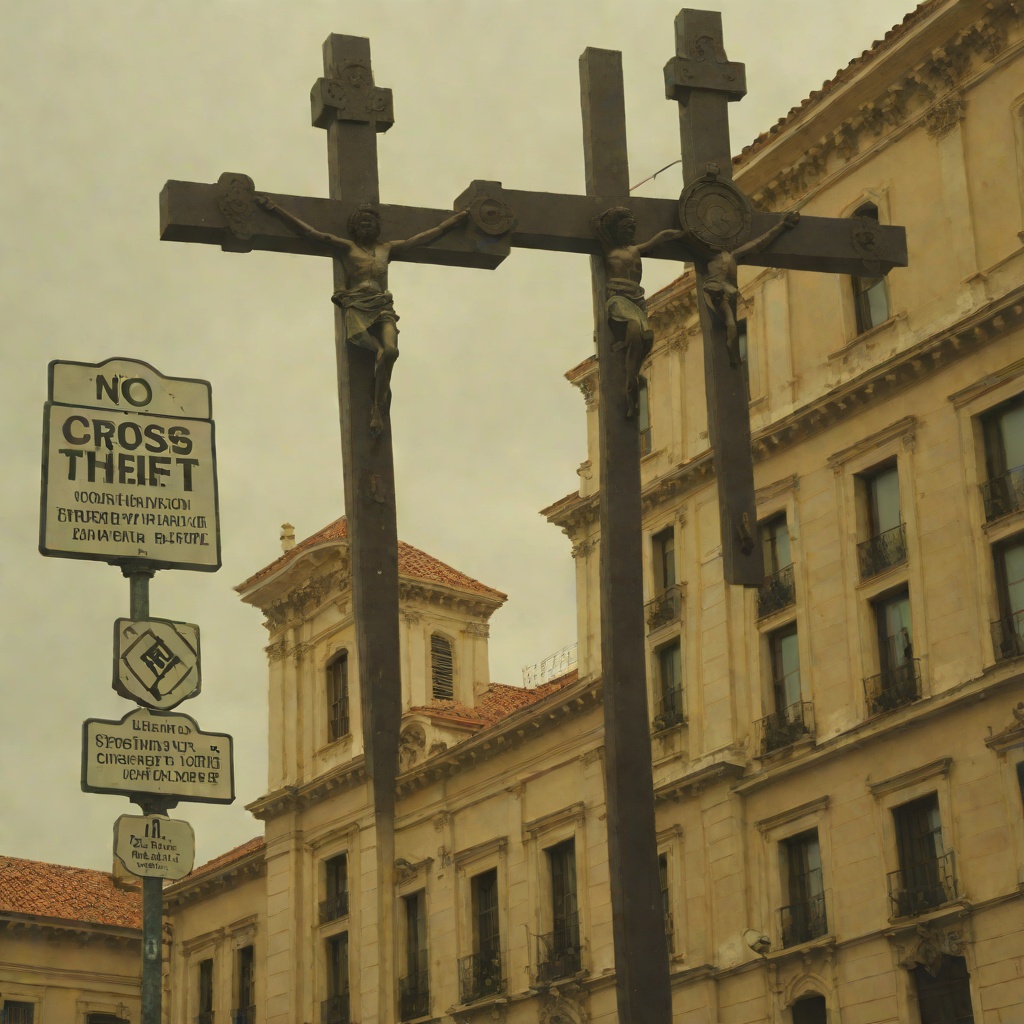
City of GodThe Appearance of the Cross on the Synagogue Roof is the central mystery and turning point of E. L. Doctorow's City of God. The eight-foot hollow brass cross of St. Timothy's Episcopal Church, stolen from behind its altar, is discovered lying flat on the tarred roof of the Synagogue of Evolutionary Judaism on West Ninety-eighth Street, its transverse exactly parallel to the front of the building and its upright pressed against the granite pediment. For the novel's protagonist, the Episcopal priest Thomas Pemberton, the event is not merely a crime to be solved but a cryptic sign that announces something momentous, transforming him from a man in professional and spiritual crisis into a self-styled detective and ultimately setting him on the path toward conversion to Judaism.
The Theft and the Discovery
The event begins with a theft. Pemberton, the rector of St. Timothy's, discovers one day that the big brass cross has been lifted from behind the altar, leaving only a shadow of the crucifix in the unfaded paint of his predecessor's poor taste. The police detective assigned to the case offers a cynical street-level assessment: thieves would hit a synagogue for the Torah, a handwritten, non-mass-produced item that could bring a minimum of five thousand dollars, whereas the book value of the cross is zilch, nada—on the street it is nothing but scrap metal. The detective, a Catholic who attends mass, notes the irony with a rueful "Jesus! whata buncha sickos." The theft itself is never solved as a conventional crime; instead, the cross reappears in a far stranger location.
Pemberton learns of the cross's whereabouts through a voice mail from Rabbi Joshua Gruen of the Synagogue of Evolutionary Judaism, who insists that it is in the priest's interest that they meet as soon as possible. Gruen is cordial but refuses to answer questions over the phone, and Pemberton, adopting the detective's investigative posture, goes to the synagogue in person. The synagogue is a brownstone between West End and Riverside Drive, a converted parlor with an Ark at one end, a platform table for reading the Torah, shelves of prayer books, and a few rows of bridge chairs. Gruen, a trim man of about thirty-two or thirty-four in sweatshirt and jeans, leads Pemberton up through the building, past his wife Sarah Blumenthal, also a rabbi, and their two young boys, and finally up an iron ladder through a trapdoor onto the flat roof. There, in the autumn sun, with the old apartment houses of West End Avenue and Riverside Drive looming at either end of the block, Pemberton sees the eight-foot hollow brass cross of St. Timothy's, Episcopal, lying tarnished and shining on the black tarred roof.
The Anonymous Call and the Unanswered Questions
The cross's placement on the roof is itself a mystery wrapped in another. Rabbi Gruen explains that he learned of the cross through an anonymous phone call: a man's voice said, "Hello, Rabbi? Your roof is burning." Gruen, fearing for the children in the house, grabbed a kitchen extinguisher and rushed up to the roof, only to find that it was not burning at all. The caller's ruse, however, was not entirely wrong: the cross was there, and the synagogue, modest as it is, is a place for prayer and study, with a Jewish family occupying the upper floors. The question of who moved the cross from wherever it was stolen to the roof—and how they did it without being seen or heard—remains unanswered. Gruen's nanny, Angelina, heard noises from the roof one morning, but thought no more of it, assuming it was a repairman. The assumption is that the movers came up through one of the houses on the block, since the roofs abut, but Gruen never went down the block to ring bells.
The identity and motive of the person or persons who placed the cross remain deliberately unresolved. Pemberton and Gruen speculate together, considering and rejecting the possibility that the original thieves were mindless creeps, or that the placement was the work of anti-Semites or Jewish ultras. Pemberton concludes that someone took the cross off the thieves' hands—or found it in a dumpster—and that this second person or persons had the intent. But the deeper question of what the placement means, whether it is an affront or something else entirely, is left open. The event resists a single interpretation, and this ambiguity is precisely its power.
The Sign and the Detective
For Pemberton, the appearance of the cross becomes a personal and theological crisis. He had already chosen the hospice across the East River as an appropriate dead end for his professional life, working among the dying, but he felt himself changing. His conviction that the appearance of the brass cross on the roof of the Synagogue of Evolutionary Judaism announced something momentous was not a proposition he was prepared to argue with anyone. He regretted mentioning it to his friend and narrator, because it belonged to a mode of thought characteristic of ancient prophetic communications which he could no longer countenance, and because he felt, with the stunning power of superstition, that to discuss it, to speak of it, was for it to lose its light. He did not think of the sign as necessarily unearthly but as so cryptic as to render the motives of the human beings who had arranged it entirely beside the point.
The sign was, in his own words, "betrayable in speech, and positioned on the edge of unreason," a challenge to his behavior. He must keep his own counsel, even as far as Sarah Blumenthal was concerned. His sign was ambiguous: he had recognized it for what it was but not for what it was instructing him to do. He felt that when he should confide in her he would know it without question, but in the meantime he had to be patient and attentive and alive to his life, "the person on whom nothing is lost." He could hope that a revelation was evolving, that it was a slow process, and that it might be manifest even in the moans of the dying. From the very beginning, even before the cross had been stolen, the events at St. Tim's had turned him into a detective of sorts, and that is what he decided his life must seriously become: a truly humble, dogged act of detection.
The Detective's Trade and the Unresolved Mystery
Pemberton's embrace of the detective role is both earnest and self-mocking. He buys half a dozen used paperback detective novels "to learn the trade," though he admits to his watchful God that he is lying—he just reads them when he is depressed. The paperback detective speaks to him; "his rod and his gaff they comfort me." The detective's world is circumscribed and dependable in its punishments, which is more than Pemberton can say for God's. This self-aware adoption of the detective genre frames the entire novel: the mystery of the cross is never fully resolved in the conventional sense, subverting the genre's promise of closure. The investigation becomes instead a vehicle for theological and existential inquiry, a way of living attentively in the face of an ambiguous and possibly unreadable divine signal.
The event also draws Pemberton into the world of the Synagogue of Evolutionary Judaism, whose members include a professor of Comparative Religion at Columbia, a judge of the State Supreme Court, a young woman studying at the Actors Studio, a married couple of physicians, a Barnard junior, and an elderly white-haired man whose son carries him up the brownstone stairs. The synagogue's weekly Sabbath services are structured as rabbinically directed seminar discussions rather than sermons, examining the Torah through the lens of modern scholarship, including the documentary hypothesis of biblical authorship. Pemberton finds much that is familiar from his days as a divinity student, and he is profoundly drawn into this community of inquiry. The cross on the roof is the occasion that brings him there, and its unresolved mystery becomes the foundation of his new life.